
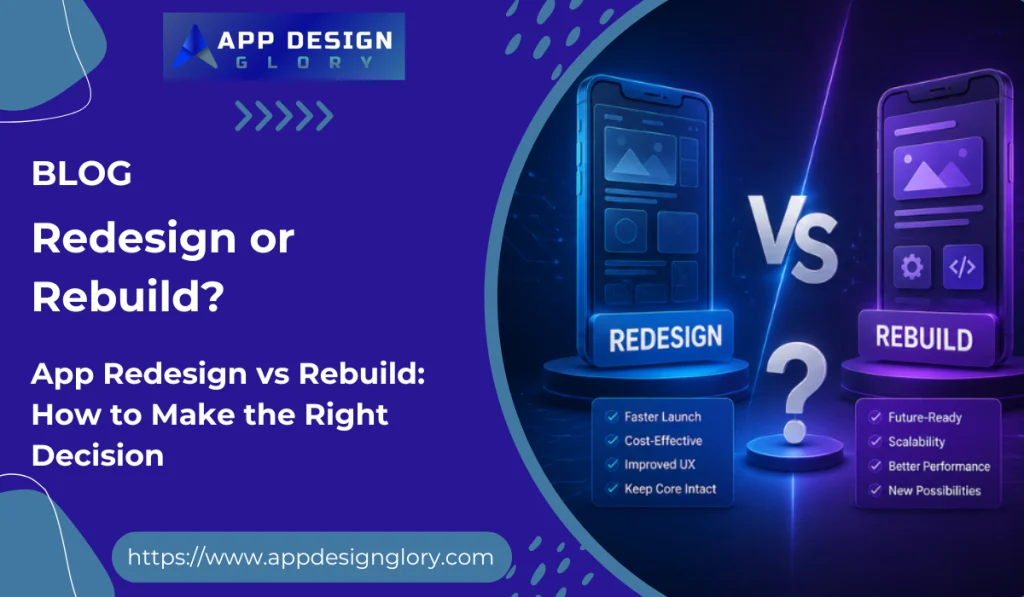
How to Identify Effective App Redesign Solutions
Introduction
You have a struggling app. Users are dropping off. Engineers are patching faster than the team ships. Investors are asking hard questions. The decision in front of you — do you redesign or rebuild — feels paralyzing because the cost of getting it wrong is massive.
This guide gives you a structured scoring framework to make that call with confidence. It also shows you exactly what to look for when evaluating app redesign services so you hire an agency that actually solves the problem instead of reskinning it.
What Is the Difference Between App Redesign and App Rebuild?
Direct Answer: App redesign addresses the user experience layer — visual design, interaction flows, information architecture, and usability. App rebuild replaces the underlying codebase or technical infrastructure. They solve fundamentally different problems. Choosing the wrong path wastes six figures and months of runway.
Here’s how the two paths compare at a structural level:
Dimension |
App Redesign |
App Rebuild |
| Primary target | UX debt, visual inconsistency, conversion friction | Technical debt, architectural failure, scalability ceiling |
| Codebase changed? | No (or minimally) | Yes — substantially or fully |
| Typical timeline | 6–16 weeks | 4–12 months |
| Relative cost | Moderate | High |
| Team composition | Designers, QA, front-end | Engineers, architects, designers, QA |
| User-visible speed | Fast | Slow |
| Best trigger | Users confused; brand evolved; onboarding fails | Engineers blocked; app crashes under load; stack is obsolete |
The most expensive mistake in product development is ordering a redesign when the problem is architectural — or ordering a rebuild when a targeted UX fix would have solved it in six weeks.
When Do Performance Issues Signal a UX Problem vs. an Engineering Problem?
Direct Answer: Performance issues are a UX problem when users perceive slowness due to absent loading states, unclear feedback, or broken interaction patterns — even if the app is technically fast. They become an engineering problem when the root cause is inefficient database queries, dependency bloat, or infrastructure debt that no UI change can resolve.
Confusing these two categories is extremely common. A founder sees “performance complaints” in App Store reviews and orders a mobile app redesign. The designers produce polished new screens. Engineering re-skins the front end. The app still crashes under load at 500 concurrent users — because the database was never indexed properly and the API calls were never cached.
Four Diagnostic Questions That Separate UX Debt from Technical Debt
Answer each honestly before committing to a path:
- Does the app crash, time out, or fail to load under normal conditions? → Yes: Engineering problem. A redesign cannot fix server instability.
- Do users complete signup and then abandon before Day 7? → Yes: UX debt is the likely culprit. Mobile app redesign is the primary lever.
- Do engineers regularly say “we can’t add that feature without breaking three others”? → Yes: Technical debt is severe. A rebuild conversation is necessary.
- Do App Store reviews use words like “confusing,” “can’t find,” or “doesn’t make sense”? → Yes: UX debt. Structured redesign addresses this directly.
If you answered yes to questions 1 and 3: rebuild. Questions 2 and 4: redesign. All four: rebuild with a UX-first design system. None: you don’t have a product problem — you have a growth or marketing problem.
How Do You Quantify Technical Debt and UX Debt Before Making a Decision?
Direct Answer: Technical debt is quantified by measuring feature delivery velocity against industry benchmarks — if a standard feature takes 3x longer than it should, debt is high. UX debt is quantified through task completion rates, session recordings, onboarding drop-off data, and support ticket language analysis. Both require measurement before any decision is valid.
Gut instinct is not a framework. Here’s how to score each type of debt objectively.
Technical Debt Scorecard
Rate each factor from 1 (low debt) to 5 (severe debt):
- Code modularity: Can engineers work on one module without touching unrelated ones?
- Test coverage: Is automated test coverage above 60%? (Industry standard for production apps)
- Dependency freshness: Are core libraries more than two major versions behind?
- Onboarding time: How many days before a new engineer ships their first feature?
- Feature velocity trend: Has time-to-ship increased meaningfully over the past 12 months?
Scoring guide:
- 20–25: Rebuild is a rational business decision.
- 12–19: Modular rebuild of high-debt components; redesign the surface layer.
- 5–11: App maintenance services and targeted hardening will sustain the product.
UX Debt Scorecard
Rate each factor from 1 (minimal debt) to 5 (severe debt):
- Task completion rate: What percentage of users complete your core action in a session?
- Onboarding completion: What percentage of new users finish the setup flow?
- Error encounter rate: How often do users hit dead ends, unclear errors, or broken states?
- D1/D7 retention: Are early retention numbers below your category benchmark?
- Support ticket language: What percentage of tickets describe UI confusion rather than bugs?
Scoring guide:
- 20–25: Full UX overhaul. Comprehensive app redesign services are justified.
- 12–19: Targeted redesign of highest-friction flows.
- 5–11: Incremental iteration. No major intervention needed yet.
Run both scorecards. Read the results together. That combination — not either score alone — tells you what you’re actually dealing with.
What Does a Legitimate Mobile App Redesign Process Actually Look Like?
Direct Answer: A legitimate mobile app redesign begins with a diagnostic audit — not wireframes. Agencies that open with deliverables before completing a heuristic evaluation, user research synthesis, and technical constraint review are designing without information. That produces beautiful products that solve the wrong problem.
At App Design Glory, our redesign engagements follow a discovery-first structure every time. Here’s what that looks like in practice:
1. Diagnostic Audit (Weeks 1–2)
- Heuristic evaluation mapped against Nielsen’s 10 usability principles
- Session recording analysis using tools like FullStory or Hotjar
- App Store and Google Play review mining for recurring user language
- Stakeholder interviews to surface assumption gaps and internal misalignments
- Technical constraint mapping with the client’s engineering team
This phase produces one document that doesn’t exist at most agencies: a written recommendation specifying whether the engagement should be a redesign, rebuild, or hybrid — before any design work begins.
2. Strategic Definition (Weeks 2–3)
- Prioritized UX debt register, ranked by user impact and fix complexity
- Success metrics defined in writing before design begins (not retroactively)
- Design system audit — what exists, what can be salvaged, what must be rebuilt
- User flow mapping against business objectives, not just user preferences
3. Design Execution (Weeks 3–12, scope-dependent)
- Design system creation or comprehensive audit (tokens, components, patterns, states)
- Wireframe → interactive prototype → usability test loop, minimum two rounds
- Accessibility compliance validation against WCAG 2.1 AA
- Developer handoff with annotated specifications, interaction notes, and edge cases
4. Implementation Support and App Maintenance Services
- Design QA during development sprints — not after launch
- Post-launch monitoring against pre-defined success metrics
- Iteration backlog prioritization at 30, 60, and 90 days
- Transition to structured app maintenance services for ongoing health
Any agency that skips Phase 1 is selling you an aesthetic upgrade dressed as a strategic solution.
Is a Hybrid Approach — Partial Redesign Plus Partial Rebuild — Ever the Right Answer?
Direct Answer: Yes — and it’s often the most commercially rational path. A hybrid approach redesigns the user-facing experience while selectively rebuilding high-debt technical modules that block roadmap execution. This generates user-visible improvements faster than a full rebuild while removing the architectural constraints that make redesign unsustainable long-term.**
Hybrid Scenarios That Make Business Sense
Scenario 1: Core transaction works but onboarding fails Redesign the onboarding flow and activation sequence. Do not touch the transaction engine. You preserve working infrastructure and fix the conversion leak in 8 weeks instead of 8 months.
Scenario 2: Brand has evolved but the codebase is sound Full visual redesign and interaction layer refresh. Apply targeted app maintenance services to stability and performance. No rebuild required.
Scenario 3: One legacy module blocks all new features Rebuild that module using React Native, Flutter, or whatever the team’s stack calls for. Redesign only the interfaces connected to it. Everything else stays in place.
Scenario 4: The UI is obsolete but the data model is clean. Rebuild the front end completely. The database schema, API contracts, and business logic remain. This is faster and lower-risk than a true ground-up rebuild.
The common thread: hybrid decisions require tight alignment between design leadership and engineering before scope is approved. At App Design Glory, we run a structured technical alignment session at the start of every hybrid engagement — because design decisions made without engineering input produce handoffs that can’t be built as specified.
How Do You Build a Decision Scoring Framework Before Committing a Budget?
Direct Answer: A valid decision framework combines quantitative debt scoring with four strategic constraint inputs — timeline pressure, budget ceiling, team capacity, and roadmap criticality. No single variable is deterministic. The framework becomes actionable when all four are read together against your debt scores.**
The Four-Variable Decision Matrix
Score each variable as High, Medium, or Low based on your current situation:
1: Debt Type
- Primarily UX debt → Redesign
- Primarily technical debt → Rebuild
- Both at roughly equal severity → Hybrid or full rebuild
2: Timeline Pressure
- Need user-visible improvement within 90 days → Redesign (fastest path to visible change)
- Willing to invest 6–12 months for structural improvement → Rebuild is viable
- Somewhere between → Hybrid with phased delivery milestones
3: Budget Ceiling
- Under $75,000 → Redesign or targeted flow improvements only
- $75,000–$250,000 → Full redesign or well-scoped hybrid
- $250,000+ → Full rebuild is on the table; evaluate carefully
4: Roadmap Criticality
- Core features blocked by current architecture → Rebuild
- Current architecture supports the next 18 months of roadmap → Redesign
- Partially blocked → Hybrid: rebuild blocking module, redesign connected interfaces
Decision Output Table
Debt Type |
Timeline |
Budget |
Roadmap |
Recommended Path |
| UX | Short | Low–Mid | Unblocked | Full redesign |
| Technical | Flexible | High | Blocked | Full rebuild |
| Both | Flexible | Mid–High | Partially blocked | Hybrid |
| UX | Short | Low | Unblocked | Targeted flow fixes + app maintenance |
| Technical | Short | Low | Blocked | Rebuild highest-impact module only |
| Neither significant | Any | Any | Unblocked | Iterate; no major intervention needed |
How Do You Vet an Agency Before Hiring for App Redesign Services?
Direct Answer: Evaluate agencies on process evidence, not portfolio aesthetics. Any agency worth hiring should show you their diagnostic methodology before showing you their work. They should explain how they made past decisions, what metrics defined success in completed projects, and what they would do differently — not just what the final screens look like.**
This is the checklist App Design Glory recommends every founder use before signing any contract for app redesign services.
The Complete Agency Vetting Checklist
Process and Methodology
- Can they articulate their discovery process in concrete, sequential steps?
- Do they conduct user research, or do they design from stakeholder assumptions alone?
- Do they define success metrics before design begins — or retroactively?
- Do they provide a written recommendation (redesign vs. rebuild vs. hybrid) before scoping?
- Is their proposed scope specific enough to hold them to, or vague enough to expand without limit?
Technical Fluency
- Do their designers understand development constraints on iOS (Apple App Store) and Android (Google Play)?
- Can they describe their handoff process to engineering in specific terms?
- Have they worked with your tech stack, or are they willing to conduct a technical constraints review?
- Do they have a position on React Native vs Flutter vs native development, and can they explain it?
Evidence of Outcomes (Not Just Outputs)
- Can they show before-and-after data — not just before-and-after screenshots?
- Do their case studies include measurable metrics: task completion rate, retention lift, conversion improvement?
- Can they provide a reference client you can call — not just a logo displayed on a landing page?
Scope and Delivery Integrity
- Does the proposal include QA and post-launch support, or does the engagement end at design handoff?
- Do they offer phased delivery with defined milestones and clear exit points?
- Is there a written process for handling scope changes, or does scope creep go unmanaged?
Non-Negotiable Red Flags — Walk Away If:
- They lead with portfolio presentations and skip diagnostic questions about your problem
- They quote a fixed price before completing a discovery audit
- They cannot name a single metric from a past project
- They have no documented process for handling scope changes
- They position themselves as “design only” with no opinion on technical feasibility or engineering constraints
- They describe every engagement as a “full redesign” regardless of what your debt scores indicate
What Role Do App Maintenance Services Play After Redesign or Rebuild?
Direct Answer: App maintenance services are not optional post-launch work. They are the mechanism by which redesign and rebuild investments hold their value over time. Without structured maintenance, UX and technical debt begin re-accumulating within weeks of launch. Apps with active maintenance programs retain significantly more of their post-launch performance gains at the 12-month mark.**
A mobile app is not a project. It is a product. Products require ongoing stewardship.
What a Structured App Maintenance Program Covers
- Performance monitoring: Launch time, frame rate, API response time — tracked against baselines established during the redesign
- Crash reporting triage: Weekly review of crash-free session rates segmented by OS version, device type, and app version
- UX regression testing: Monthly audit of core flows against pre-launch baseline metrics
- Dependency management: Quarterly library updates to prevent security vulnerabilities and compatibility debt from accumulating
- Roadmap iteration: Prioritized backlog review at 30, 60, and 90 days post-launch, informed by real user behavior data
At App Design Glory, every redesign and rebuild engagement includes a minimum 90-day structured maintenance and monitoring period. This protects the outcomes we committed to delivering — and gives founders the data they need to make the next roadmap decision with confidence.
What Are the Most Common Mistakes Founders Make in This Decision?
Direct Answer: The most common mistake is starting with a solution instead of a diagnosis — ordering a redesign or rebuild before measuring what’s actually wrong. The second most common mistake is hiring for aesthetics instead of outcomes, selecting an agency based on visual portfolio quality rather than documented process and measurable past results.**
Six Mistakes That Waste Budget and Delay Recovery
- Treating symptoms instead of causes. Slow user growth is not automatically a UX problem. Analyze the data before prescribing the solution.
- Underestimating technical debt before scoping a redesign. A redesign built on a crumbling codebase will degrade in months. Always run the technical debt scorecard first.
- Skipping user research to save time. Designing without current user data is designing for an assumed user who may no longer exist. Session recordings and task completion data are non-negotiable inputs.
- Selecting an agency on aesthetics. Beautiful Dribbble shots and polished case study PDFs do not indicate strategic capability. Ask for metrics. If there are none, move on.
- Treating launch as the finish line. Redesigns and rebuilds that lack post-launch maintenance programs lose most of their gains within a year. Ongoing app maintenance services are part of the investment, not an optional add-on.
- Confusing brand refresh with product redesign. Updating colors, typography, and marketing assets is brand work. It does not fix broken navigation, poor onboarding, or confused information architecture. These are different scopes with different outcomes.
What Does the Future of App Redesign Look Like?
Direct Answer: App redesign is shifting from periodic major overhauls toward continuous improvement cycles driven by real-time behavioral data. Design systems, component libraries, and AI-assisted prototyping are compressing redesign timelines. The most competitive products in 2025 and beyond will treat redesign not as a project but as an ongoing practice.**
Several forces are accelerating this shift:
- Design system maturity: Products built on atomic design systems (tokens, components, patterns) can redesign at the surface layer without touching architecture. This makes incremental redesign faster and lower-risk than it was three years ago.
- Behavioral analytics infrastructure: Tools integrated with Firebase, Mixpanel, and Amplitude give teams continuous access to the data that used to require a research sprint. Redesign decisions can be made with higher confidence and lower research overhead.
- Cross-platform frameworks: React Native and Flutter have narrowed the gap between native iOS and Android performance while sharing a single codebase. This changes the rebuild calculus — full rebuilds on these frameworks are often faster and cheaper than rebuilding each platform natively.
- AI-assisted prototyping: Figma’s AI features and emerging prototyping tools are compressing the time between concept and testable prototype. This reduces the cost of testing redesign hypotheses before committing to build.
The practical implication for founders: the question is no longer “should we do a big redesign this year?” It’s “do we have the infrastructure to continuously improve?” That infrastructure — design systems, behavioral analytics, structured app maintenance services — is what App Design Glory builds alongside the product itself.
Related Resources
Before making any final decisions, these articles will sharpen your thinking:
Article |
Suggested URL |
Why It Helps |
| How to Build a Mobile App Design System From Scratch | /mobile-app-design-system-guide | Understand the infrastructure that makes continuous redesign possible and affordable |
| UX Audit: What It Is and When Your App Needs One | /ux-audit-guide | Learn the diagnostic process that precedes every valid redesign recommendation |
| Mobile App Onboarding Design: Best Practices and Patterns | /mobile-app-onboarding-design | Most UX debt concentrates in onboarding; fix it first for fastest ROI |
| How to Choose an App Design Agency: Full Vetting Guide | /how-to-choose-app-design-agency | Expand on the vetting checklist in this article with a full evaluation framework |
| Technical Debt in Mobile Apps: What It Costs and How to Address It | /technical-debt-mobile-apps | Deep-dive into the engineering dimension of the rebuild decision |
The Decision in Front of You
Making the wrong call here doesn’t just cost money. It costs the one thing early-stage products can’t buy back: time. A redesign applied to an architectural problem takes six months before the same issues resurface. A rebuild ordered when targeted UX improvements would have burned a year of runway and team morale.
The framework in this article is designed to take that decision out of instinct and into evidence. Score your debt. Map your constraints. Vet your agency on process, not portfolio.
If you’re not sure where your product scores — or you want a second opinion before committing a budget — App Design Glory offers structured diagnostic audits that produce a written recommendation before any design work begins. That’s not a sales process. It’s the only responsible way to scope work that will actually deliver outcomes.
About the Author
This article was produced by the Strategy and UX team at App Design Glory, a U.S.-focused mobile app design and product strategy agency. The App Design Glory team specializes in mobile app redesign, design systems, MVP development, and product strategy for growth-stage startups and enterprise product teams.
The team brings hands-on experience across iOS and Android product design, cross-platform development with React Native and Flutter, and UX research methodologies including heuristic evaluation, usability testing, and behavioral analytics interpretation. Every engagement is anchored in measurable outcomes — not deliverable counts.
App Design Glory works with founders, product leaders, and engineering teams who need more than good-looking screens. They need a design partner who understands what the numbers mean, what the codebase can support, and what decision to make before the first wireframe is drawn.
Explore App Design Glory’s Services
Frequently Asked Questions (FAQs)
How do I know if my app needs a redesign or a full rebuild?
Start by separating symptoms from root causes. If users report confusion, drop off during onboarding, or can’t locate core features, you likely have UX debt that professional app redesign services can resolve. If engineers say new features are architecturally impossible, or the app crashes at normal load levels, the problem is structural. Run the debt scorecards in this article to quantify both, then read the scores against your timeline, budget, and roadmap constraints. A score above 18 on either scale indicates major intervention is warranted.
How much does a mobile app redesign cost in the U.S.?
Scope drives cost more than any other single variable. A targeted redesign of two to three high-friction flows typically runs $25,000–$60,000. A full product redesign including a new design system, user research, and engineering implementation support ranges from $75,000 to $200,000 or more. A hybrid redesign-plus-partial-rebuild engagement starts around $150,000 and scales with engineering complexity. Agencies quoting below these ranges without completing a discovery audit are pricing without adequate information — a significant risk signal.
What’s the biggest mistake founders make when hiring for app redesign services?
Selecting on portfolio aesthetics instead of process evidence. Beautiful screens are straightforward to produce. Solving the correct problem requires structured diagnostic methodology, user research infrastructure, and honest written recommendations. Before hiring any agency, ask them to walk you through their last three redesign decisions — specifically what they advised against and why. Agencies that only show what they built, and never what they recommended against, are not operating at a strategic level.
How long do app maintenance services need to continue after a redesign?
A minimum of 90 days of active post-launch monitoring is non-negotiable for any redesign engagement. Six months is a responsible baseline. Ongoing structured app maintenance services — covering performance monitoring, dependency management, crash triage, and UX regression testing — should continue indefinitely on a retainer model. The annual cost of structured maintenance is consistently lower than the cost of re-accumulating debt and running a second redesign cycle 18 months later.
Can we do a redesign without involving engineering?
Not if you want the redesign to stick. A redesign that ignores technical constraints produces handoffs engineers can’t build as specified, or can only build through workarounds that introduce new technical debt immediately. At minimum, engineering must participate in the constraints review at the start of the engagement, and design QA must run during implementation sprints — not only after launch. Design and engineering working in silos is one of the primary reasons redesigns underdeliver.
When should a startup choose a full rebuild over a redesign?
When the cost of maintaining the current architecture has exceeded the cost of replacing it. Practical signals: feature velocity has declined more than 50% in 12 months; more than one senior engineer has cited the codebase as the reason they’re leaving; adding a feature consistently requires touching more than three unrelated modules; or the tech stack lacks active community support, security patches, or compatibility with current iOS and Android requirements. If two or more of these apply, rebuild is the correct long-term decision.
Ready to Improve Your App?
Book your free consultation today and get a clear roadmap for your app’s next stage of growth.