
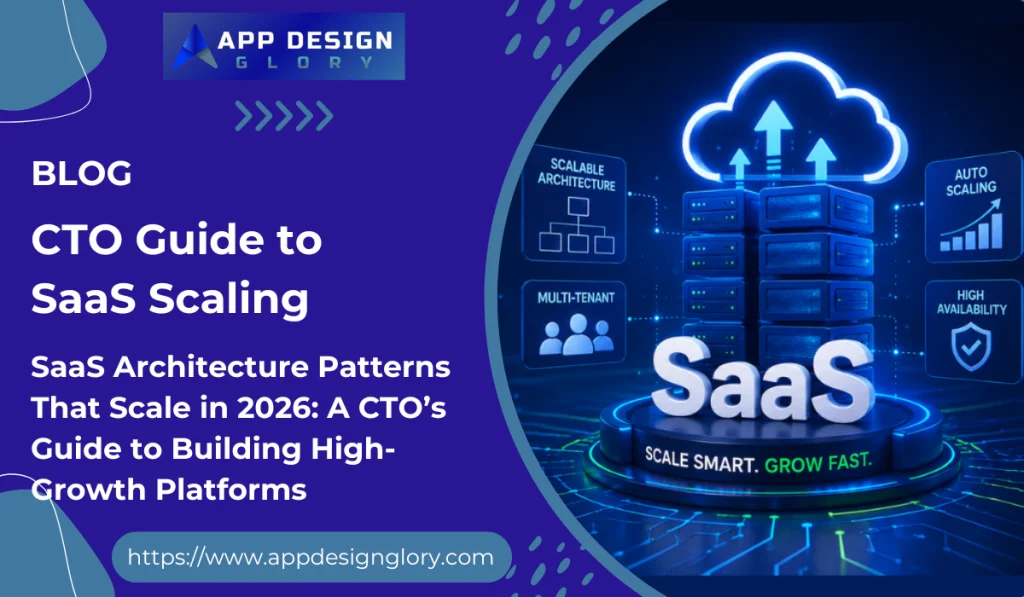
SaaS Architecture Patterns That Scale in 2026
Introduction
Growth is exciting—until your platform starts slowing down, infrastructure costs surge, and engineering teams spend more time fighting fires than building features.
Many SaaS founders discover too late that scaling problems rarely begin with traffic. They begin with architecture.
A SaaS product that supports 1,000 users can fail under the demands of 100,000 users if its underlying architecture was never designed for growth. Poor architectural decisions lead to performance bottlenecks, database contention, deployment delays, security vulnerabilities, and expensive platform rewrites.
In 2026, successful SaaS companies are taking an architecture-first approach. Rather than reacting to growth challenges, they design systems capable of handling increasing workloads, expanding customer bases, and evolving product requirements from day one.
This guide explores the SaaS architecture patterns, infrastructure strategies, and scalability frameworks used by modern high-growth software companies.
Quick Answer
Scalable SaaS architecture in 2026 combines cloud-native infrastructure, intelligent multi-tenancy, microservices where appropriate, distributed systems principles, automated scaling, resilient data management, and observability. The best SaaS platforms are designed to handle growth without major architectural rewrites by prioritizing flexibility, performance, security, and operational efficiency from the beginning.
What Is SaaS Architecture?
Direct Answer
SaaS architecture is the structural design of a software-as-a-service platform, including its applications, infrastructure, databases, integrations, security systems, deployment processes, and scaling mechanisms.
Expanded Explanation
Think of SaaS architecture as the blueprint that determines how every component of your platform interacts.
It defines:
- How users access the application
- How data is stored
- How services communicate
- How workloads scale
- How updates are deployed
- How security is enforced
Strong architecture enables growth.
Weak architecture creates bottlenecks.
The quality of your architecture often determines whether your SaaS product becomes a market leader or struggles with reliability and performance issues.
Example
A project management SaaS platform may include:
- Frontend application
- API layer
- Authentication service
- Billing service
- Notification service
- Customer database
- Analytics engine
- Cloud infrastructure
Each component must work together efficiently as user demand increases.
Action Step
Document your current architecture and identify potential bottlenecks before scaling pressures emerge.
Quick Fact
Companies rarely fail because they gain too many customers.
They fail because their architecture cannot support customer growth efficiently.
Why SaaS Scalability Matters More Than Ever in 2026
Direct Answer
Scalability is critical because customer expectations, data volumes, AI workloads, and integration complexity continue increasing every year.
Expanded Explanation
Today’s SaaS platforms face challenges that did not exist a decade ago.
These include:
- AI-powered features
- Real-time analytics
- Global user bases
- Continuous deployment
- Enterprise integrations
- Compliance requirements
- Multi-device experiences
As products become more sophisticated, infrastructure demands increase dramatically.
Modern users expect:
- Near-instant page loads
- Zero downtime
- High availability
- Seamless upgrades
- Enterprise-grade security
Architectures built for yesterday’s workloads often struggle to meet today’s expectations.
Real-World Scenario
Imagine a SaaS analytics platform serving 5,000 customers.
A successful product launch drives growth to 50,000 customers within six months.
Without scalable architecture:
- Database queries slow down
- API latency increases
- Infrastructure costs spike
- Deployments become risky
- Customer churn rises
With scalable architecture:
- Resources expand automatically
- Performance remains stable
- Teams deploy confidently
- Growth becomes manageable
Expert Insight
The biggest scalability challenge is rarely server capacity.
It is usually architectural coupling between systems that prevents independent scaling.
Core Components of Modern SaaS Architecture
What Components Make Up a Scalable SaaS Platform?
Direct Answer
A scalable SaaS platform typically consists of presentation layers, APIs, business services, databases, cloud infrastructure, monitoring systems, security controls, and deployment pipelines.
Expanded Explanation
Modern SaaS architecture includes several critical layers.
User Interface Layer
Technologies commonly include:
- React
- Angular
- Vue
- Mobile applications
The UI should remain independent from backend business logic.
Application Layer
Handles:
- Business rules
- Validation
- Workflows
- User permissions
API Layer
Provides communication between:
- Frontend applications
- Mobile apps
- Third-party integrations
- Internal services
Data Layer
Often includes:
- PostgreSQL
- MongoDB
- Redis
- Data warehouses
Infrastructure Layer
Frequently powered by:
- Amazon Web Services
- Google Cloud
- Microsoft Azure
Observability Layer
Includes:
- Logging
- Monitoring
- Alerting
- Performance tracking
Technical Observation
High-growth SaaS companies treat observability as a core architectural requirement rather than an afterthought.
The Evolution of SaaS Architecture Patterns
How Have SaaS Architectures Changed?
Direct Answer
SaaS architectures have evolved from simple monolithic systems to cloud-native, distributed, service-oriented platforms capable of scaling independently.
Generation 1: Traditional Monoliths
Characteristics:
- Single codebase
- Shared database
- Single deployment
Advantages:
- Faster initial development
- Simpler debugging
Disadvantages:
- Difficult scaling
- Slower deployments
- Growing technical debt
Generation 2: Service-Oriented Architectures
Characteristics:
- Separated business domains
- API communication
- Independent modules
Benefits:
- Better maintainability
- Improved flexibility
Generation 3: Cloud-Native Architectures
Characteristics:
- Containers
- Orchestration
- Auto-scaling
- Infrastructure automation
Tools commonly include:
- Docker
- Kubernetes
- CI/CD pipelines
Generation 4: AI-Ready SaaS Architectures
Emerging architectures increasingly support:
- AI agents
- LLM integrations
- Real-time inference
- Vector databases
- Event-driven processing
Key Takeaway
The future belongs to architectures designed for adaptability rather than simply supporting today’s requirements.
Monolithic vs Microservices Architecture
Which Architecture Pattern Scales Better?
Direct Answer
Microservices generally provide superior scalability for mature SaaS platforms, while monoliths often remain the best choice for early-stage products.
Expanded Explanation
The right choice depends on business maturity.
Monolithic Architecture
Advantages:
- Faster development
- Lower operational complexity
- Easier testing
- Lower costs
Challenges:
- Scaling limitations
- Larger deployments
- Tight coupling
Best for:
- MVPs
- Early-stage startups
- Small engineering teams
Microservices Architecture
Advantages:
- Independent scaling
- Faster deployments
- Team autonomy
- Better fault isolation
Challenges:
- Increased complexity
- Distributed debugging
- Service coordination
Best for:
- Growth-stage SaaS
- Enterprise platforms
- Large engineering organizations
Comparison Table
Factor |
Monolith |
Microservices |
| Initial Development | Faster | Slower |
| Operational Complexity | Lower | Higher |
| Scalability | Moderate | High |
| Team Independence | Low | High |
| Deployment Flexibility | Limited | Excellent |
| Infrastructure Cost | Lower | Higher |
Expert Insight
One of the most common mistakes is adopting microservices too early.
Premature architectural complexity can slow product development more than it improves scalability.
Action Step
Start with a modular monolith and extract services only when measurable scaling needs emerge.
Technical Tip
A well-designed modular monolith often outperforms poorly implemented microservices.
Architecture quality matters more than architecture trendiness.
Multi-Tenant Architecture Models
Why Is Multi-Tenancy Essential for SaaS?
Direct Answer
Multi-tenancy allows multiple customers to share infrastructure while maintaining data isolation, reducing costs and improving operational efficiency.
Expanded Explanation
Most successful SaaS products rely on multi-tenant architectures.
The challenge is balancing:
- Cost efficiency
- Security
- Performance
- Flexibility
Shared Database, Shared Schema
All tenants share:
- Database
- Tables
Advantages:
- Lowest cost
- Simplest management
Challenges:
- Data isolation complexity
- Scaling limitations
Best for:
- Early-stage SaaS
Shared Database, Separate Schemas
Each tenant receives:
- Dedicated schema
- Shared infrastructure
Advantages:
- Better isolation
- Easier customization
Challenges:
- Management overhead
Dedicated Database Per Tenant
Each customer receives:
- Separate database
- Maximum isolation
Advantages:
- Enterprise security
- Performance isolation
Challenges:
- Higher infrastructure costs
Best for:
- Enterprise SaaS
- Regulated industries
Technical Observation
Enterprise SaaS providers increasingly adopt hybrid tenancy models, allowing infrastructure strategies to vary based on customer size and compliance requirements.
Cloud Architecture Foundations for SaaS Growth
What Cloud Architecture Best Supports Scalability?
Direct Answer
Cloud-native architectures built around elasticity, automation, resilience, and distributed infrastructure provide the strongest foundation for long-term SaaS growth.
Expanded Explanation
Cloud architecture is no longer optional.
It is the foundation of scalable SaaS operations.
Critical capabilities include:
Auto Scaling
Resources increase automatically during demand spikes.
Benefits:
- Lower costs
- Better performance
- Improved availability
Load Balancing
Traffic is distributed across servers.
Benefits:
- Reduced bottlenecks
- Improved resilience
Containerization
Using tools such as Docker allows applications to run consistently across environments.
Benefits:
- Faster deployments
- Greater portability
- Reduced environment issues
Orchestration
Platforms such as Kubernetes automate:
- Scheduling
- Scaling
- Recovery
- Resource allocation
Distributed Storage
Modern SaaS systems often separate:
- Operational databases
- Analytics databases
- Object storage
- Caching layers
Technical Observation
Database architecture remains the most common scalability bottleneck in SaaS applications.
Application scaling is often easier than data-layer scaling.
The SCALE Framework™ for SaaS Growth
To evaluate architectural readiness, use the SCALE Framework.
S — Separation of Concerns
Ensure:
- Services remain independent
- Business logic is modular
- Dependencies are minimized
C — Cloud-Native Infrastructure
Adopt:
- Containers
- Automation
- Elastic resources
A — Availability Engineering
Design for:
- Failure recovery
- Redundancy
- High uptime
L — Load Distribution
Implement:
- Load balancing
- Caching
- Queue systems
E — Evolution Readiness
Architect for:
- Future integrations
- AI capabilities
- Product expansion
Expert Insight
The most scalable SaaS platforms are not designed for today’s traffic.
They are designed for tomorrow’s unknown requirements.
Actionable Recommendation
Run an architecture review every six months and score each area of the SCALE Framework from 1–10 to identify future growth risks before they become production issues.
Need a second opinion on your SaaS architecture?
A short architecture review can uncover scalability bottlenecks, security gaps, and costly technical debt before they impact growth. Connect with App Design Glory for a free technical consultation and actionable recommendations tailored to your platform.
Distributed Systems Principles Every SaaS Leader Should Understand
What Are Distributed Systems?
Direct Answer
Distributed systems are collections of independent services and infrastructure components that work together to deliver a unified application experience.
Expanded Explanation
As SaaS products scale, a single server or application becomes insufficient.
Modern platforms distribute workloads across:
- Multiple servers
- Multiple databases
- Multiple geographic regions
- Multiple services
This architecture improves:
- Reliability
- Performance
- Fault tolerance
- Scalability
Examples include:
-
- Payment processing systems
- Video streaming platforms
- Enterprise SaaS applications
- AI-powered software products
Example
An enterprise CRM platform may separate:
- User authentication
- Customer records
- Reporting
- Billing
- Notifications
Each service operates independently while communicating through APIs and messaging systems.
Expert Insight
The goal of distributed systems is not complexity.
The goal is resilience and independent scalability.
Load Balancing Strategies for Scalable SaaS Platforms
How Does Load Balancing Improve SaaS Performance?
Direct Answer
Load balancing distributes traffic across multiple servers and services to improve reliability, availability, and response times.
Expanded Explanation
Without load balancing:
- Servers become overloaded
- Response times increase
- Failures affect all users
With load balancing:
- Traffic is distributed intelligently
- Resources are utilized efficiently
- Downtime risk decreases
Common Load Balancing Approaches
Round Robin
Requests rotate evenly across servers.
Best for:
- Simple workloads
- Predictable traffic patterns
Least Connections
Traffic routes to servers with the fewest active sessions.
Best for:
- Variable workloads
Geographic Routing
Users connect to the nearest region.
Best for:
- Global SaaS products
AI-Assisted Traffic Routing
Increasingly used in 2026 for:
- Dynamic scaling decisions
- Predictive resource allocation
- Performance optimization
Technical Tip
Application-layer bottlenecks often appear before infrastructure bottlenecks. Monitor API response times continuously.
Database Scaling Strategies for SaaS Growth
Why Does Database Architecture Matter So Much?
Direct Answer
Databases are often the first component to experience scalability challenges because nearly every user action depends on data access.
Expanded Explanation
As customer numbers grow:
- Queries increase
- Storage requirements expand
- Reporting workloads intensify
- Concurrent usage rises
Poor database architecture can slow an entire platform.
Horizontal Scaling
Adds more database nodes.
Benefits:
- Greater capacity
- Improved resilience
Challenges:
- Increased complexity
Read Replicas
Separate read operations from write operations.
Benefits:
- Improved performance
- Reduced database strain
Database Sharding
Splits data across multiple databases.
Benefits:
- Massive scalability potential
Challenges:
- Operational complexity
Caching Layers
Common technologies include:
- Redis
- Memcached
Benefits:
- Reduced query load
- Faster response times
Technical Observation
Many scalability problems can be solved through intelligent caching before database upgrades become necessary.
Security Architecture for Modern SaaS Platforms
How Should SaaS Security Be Designed?
Direct Answer
Security must be embedded into architecture from the beginning rather than added later.
Expanded Explanation
Modern SaaS platforms face growing security demands.
Security architecture should include:
Identity and Access Management
Capabilities include:
- Role-based access control
- Single sign-on
- Multi-factor authentication
Data Protection
Requirements include:
- Encryption at rest
- Encryption in transit
- Key management
Application Security
Best practices include:
- Secure APIs
- Dependency scanning
- Automated testing
Infrastructure Security
Includes:
- Network segmentation
- Firewalls
- Monitoring
- Threat detection
Expert Insight
Security architecture scales more effectively when designed around least-privilege principles from day one.
Quick Fact
Enterprise buyers increasingly evaluate security architecture before evaluating product features.
AI-Ready SaaS Architecture in 2026
How Is AI Changing SaaS Architecture?
Direct Answer
AI capabilities are introducing new architectural requirements related to inference workloads, data pipelines, vector storage, and model orchestration.
Expanded Explanation
Many SaaS platforms now incorporate:
- Generative AI
- Intelligent automation
- Conversational interfaces
- Predictive analytics
These capabilities require additional infrastructure layers.
New Architectural Components
AI Service Layer
Handles:
- Model inference
- Prompt orchestration
- Agent workflows
Vector Databases
Support:
- Semantic search
- Knowledge retrieval
- AI assistants
Event-Driven Processing
Supports:
- Real-time AI actions
- Workflow automation
- Background processing
AI Governance Layer
Controls:
- Data access
- Model monitoring
- Compliance
Technical Observation
Many organizations underestimate the infrastructure impact of AI features. AI workloads often scale differently from traditional SaaS workloads.
SaaS Architecture Decision Model
How Should Founders Choose an Architecture?
Use the ARCH Model.
A — Anticipated Growth
Questions:
- How quickly will usage increase?
- What is the projected customer volume?
R — Resource Availability
Questions:
- What engineering expertise exists?
- What budget constraints apply?
C — Complexity Tolerance
Questions:
- Can the team support distributed systems?
- Can operations handle microservices?
H — Horizon Planning
Questions:
- Where will the product be in three years?
- What future requirements are likely?
Example
A startup with:
- Small team
- Limited budget
- Early-stage product
May benefit from:
- Modular monolith
- Shared tenancy
- Managed cloud services
An enterprise SaaS company may require:
- Microservices
- Multi-region infrastructure
- Advanced observability
Key Takeaway
Architecture decisions should align with business reality, not industry trends.
SaaS Scalability Implementation Checklist
Use this checklist to evaluate architecture readiness.
Infrastructure
- Cloud-native deployment
- Auto-scaling enabled
- Load balancing configured
- Disaster recovery strategy documented
- Infrastructure automation implemented
Application Architecture
- Modular services
- API-first design
- Deployment automation
- Monitoring coverage
- Performance testing completed
Database Architecture
- Backup strategy defined
- Read scalability addressed
- Caching implemented
- Query optimization completed
- Growth forecasts documented
Security
- MFA available
- Encryption enforced
- Access controls implemented
- Vulnerability scanning automated
- Compliance requirements reviewed
Operations
- Incident response process established
- Observability dashboards configured
- Capacity planning reviewed
- SLA targets documented
- Cost monitoring implemented
Common SaaS Architecture Mistakes
Mistake 1: Building for Millions of Users Too Early
Overengineering delays product validation.
Better Approach
Build for the next growth stage, not the final stage.
Mistake 2: Ignoring Database Scalability
Applications can often scale faster than databases.
Better Approach
Design database strategy early.
Mistake 3: Adopting Microservices Prematurely
Microservices increase operational complexity.
Better Approach
Begin with modular architecture.
Mistake 4: Neglecting Observability
You cannot optimize what you cannot measure.
Better Approach
Implement monitoring from day one.
Mistake 5: Treating Security as a Future Problem
Security debt compounds rapidly.
Better Approach
Embed security into architectural decisions.
Best Practices for Building a Scalable SaaS Platform
- Prioritize simplicity first.
- Design around clear service boundaries.
- Use cloud-native infrastructure.
- Automate deployments early.
- Implement observability before problems emerge.
- Plan database growth proactively.
- Build security into architecture.
- Use caching aggressively where appropriate.
- Continuously review scalability assumptions.
- Align architecture with business goals.
How a SaaS Development Company Can Accelerate Scalability
Building scalable architecture requires experience across:
- Cloud engineering
- Software architecture
- DevOps
- Security
- Performance optimization
- Product strategy
Many founders discover that architecture decisions made during the first year influence development velocity and infrastructure costs for years afterward.
An experienced SaaS development company can help:
- Evaluate architecture readiness
- Design scalable systems
- Reduce technical debt
- Accelerate product delivery
- Improve infrastructure efficiency
- Support digital transformation initiatives
For organizations building growth-oriented platforms, partnering with experienced architects often reduces the risk of expensive replatforming projects later.
At App Design Glory, architecture planning is approached as a business-growth initiative rather than a purely technical exercise. The objective is to build scalable SaaS platforms that support evolving customer needs, product expansion, AI capabilities, and enterprise requirements without unnecessary complexity.
Key Takeaways
Quick Fact
Scalability problems are easier to prevent than to fix.
Expert Insight
The most successful SaaS platforms evolve architecture continuously rather than relying on one-time redesigns.
Technical Tip
Measure architecture performance using business outcomes such as deployment speed, uptime, customer retention, and operational efficiency—not infrastructure metrics alone.
Key Takeaway
Scalable SaaS architecture combines:
- Cloud-native infrastructure
- Intelligent multi-tenancy
- Strong security
- Database optimization
- Observability
- Operational automation
- Future-ready design
Organizations that invest in architecture early are better positioned to scale efficiently, launch new capabilities faster, and compete effectively in increasingly demanding markets.
Conclusion
The SaaS companies that dominate their markets in 2026 are not necessarily the ones with the most features.
They are the ones with architectures capable of supporting rapid innovation, increasing customer demand, and evolving technology requirements.
Scalable SaaS architecture is no longer a technical luxury.
It is a strategic business advantage.
Whether you’re launching a new product, modernizing a legacy platform, or preparing for rapid growth, the architectural decisions made today will influence performance, security, operational costs, and customer satisfaction for years to come.
A thoughtful architecture-first approach reduces risk, improves agility, and creates a foundation capable of supporting long-term success.
If you’re evaluating your current SaaS architecture or planning a new scalable SaaS platform, App Design Glory can help assess architectural readiness, identify scalability risks, and recommend a growth-focused implementation strategy aligned with your business goals.
Frequently Asked Questions
What is SaaS architecture?
SaaS architecture is the framework that defines how software applications, databases, infrastructure, APIs, security systems, and services interact within a software-as-a-service platform.
What is the best architecture for SaaS applications?
The best architecture depends on business requirements, growth expectations, team size, and operational capabilities. Most successful platforms use cloud-native architectures with modular services and scalable infrastructure.
Is microservices architecture always better than a monolith?
No. Monoliths are often better for startups and early-stage products because they reduce complexity and accelerate development.
What is multi-tenancy in SaaS?
Multi-tenancy allows multiple customers to share infrastructure while maintaining logical separation of data and resources.
Why is cloud architecture important for SaaS?
Cloud architecture provides elasticity, reliability, automation, and scalability that traditional infrastructure struggles to deliver.
What causes SaaS scalability issues?
Common causes include database bottlenecks, tightly coupled systems, poor caching strategies, inefficient APIs, and inadequate infrastructure planning.
How do SaaS platforms scale databases?
Methods include read replicas, sharding, caching, query optimization, and distributed database architectures.
What role does Kubernetes play in SaaS architecture?
Kubernetes automates deployment, scaling, resource allocation, and infrastructure management for containerized applications.
What is a scalable SaaS platform?
A scalable SaaS platform can support increasing workloads, users, transactions, and features without significant performance degradation.
How does load balancing improve SaaS performance?
Load balancing distributes traffic across resources, reducing bottlenecks and improving availability.
What is cloud-native SaaS architecture?
Cloud-native architecture is designed specifically for cloud environments using containers, automation, orchestration, and elastic infrastructure.
How does AI affect SaaS architecture?
AI introduces requirements such as model inference services, vector databases, workflow orchestration, and real-time data processing.
What security measures should SaaS platforms implement?
Encryption, identity management, access controls, monitoring, compliance frameworks, and secure development practices are essential.
When should a startup move to microservices?
Typically after product-market fit is established and operational complexity is justified by growth requirements.
How often should SaaS architecture be reviewed?
At minimum every six months or whenever significant growth, infrastructure changes, or product expansions occur.
What are the most important SaaS architecture metrics?
Availability, latency, deployment frequency, recovery time, infrastructure cost efficiency, and customer experience metrics.
How can a SaaS development company help?
A SaaS development company can provide architecture planning, cloud implementation, scalability assessments, security guidance, and engineering expertise.
What is the biggest SaaS architecture mistake?
Building overly complex systems before business growth justifies the complexity.
About the Author
The App Design Glory editorial team consists of software architects, cloud engineers, product strategists, and digital transformation consultants with experience designing, developing, and scaling SaaS platforms across startup, growth-stage, and enterprise environments. Content is created to help business leaders make informed technology decisions based on practical implementation experience and proven engineering principles.
Editorial Process
Every article published by App Design Glory follows a structured review process:
- Search intent analysis
- Technical accuracy verification
- Architecture and engineering review
- EEAT validation
- SEO and GEO optimization review
- Readability assessment
- Fact-checking and editorial approval
- Final publication review
Content is designed to provide practical, evidence-based guidance while maintaining accuracy, transparency, and relevance for technology decision-makers.
Ready to Scale with Confidence?
Whether you’re building a new SaaS product or preparing an existing platform for growth, the right architecture can save years of rework. Talk to App Design Glory for a free technical consultation and get expert guidance on creating a scalable, secure, and future-ready SaaS platform.